

 cite
citePreface
This edited volume brings together contributions focused on the computational analysis of popular poetic forms, both traditional and contemporary, as well as song lyrics (for instance in folk, pop, or rap) and other studies of poetic text following a quantitative or computational approach. Particular attention is given to the relationships between text and performance, and to poetic expression disseminated through new media platforms such as the social web.Through the diversity of materials addressed, ranging from German Romantic poetry to Estonian hip-hop, and from Icelandic verse to Bukowski’s performances, the contributions share and offer an understanding of poetry as a complex phenomenon that exceeds the boundaries of print, unfolding across multiple media, traditions, and reception contexts. Collectively, the papers demonstrate how digital humanities approaches enable novel forms of analysis, showing that quantitative methods do not flatten poetic texts into abstract data nor disregard their aesthetic dimensions. Rather, processes of formalisation, from basic counting procedures to advanced algorithmic modelling, provide productive means to analyse, describe, interpret, and access poetic works in ways that both complement and expand established scholarly practices.
The volume opens with the transcript of a keynote address by Mustazza, in which he examines the relationship between literary audio and popular voices in dialect recordings in the early 20th century. His serious reflection on the question of voices, performance and perception, forms the matter of an actual performance and, as such, has been kept intact, transcribed by the author, allowing readers to appreciate and enjoy its dual nature: at once scholarly and performative.
As for the other, peer-reviewed articles in this volume, several of them address historical corpora, in most cases focusing on the poetry–music relationship they display. Helgadóttir discusses methods to find structural units and their variants in postmedieval Icelandic þulur, a folk poetry genre. Seláf et al. investigate 16th-century Hungarian epic poetry, computationally identifying traces and features of traditional sung poetry within early written poetic texts. Couturier & Nugues introduce a database documenting tune reuse across a corpus of vaudeville couplets and songs from the 19th and 20th centuries. Polilova examines the deployment of Russian Dk3 meter (three-ictic dolnik) in the translation of Spanish romances, situating these findings in relation to both original dolnik rhythms and dolnik usage in Russian translations of Heine. Koch et al. provide a quantitative survey of textual, prosodic and sonic aspects in The Boy’s Magic Horn (Des Knaben Wunderhorn), an early 19th-century German collection of poems appreciated in both folk culture and ‘high’ culture contexts, including its musical settings by composers such as Mahler and Brahms. Their contribution also reports on speech synthesis experiments trained on poetic corpora.
Shifting to the interplay between poetry and 20th and 21st-century popular song, Macaud presents a study of the online remediation of Bukowski’s poetry performances drawing on a corpus of YouTube videos by amateur readers. Lotman & Lotman compare rhyming patterns by two Estonian rap artists with those found in Estonian literary poetry, identifying innovative rhyming strategies in Estonian rap that emerge through contact with Western models. Martínez et al. examine textual transformations in musical adaptations (since 1975) of poems in Spanish, using automatic collation followed by manual annotation to account for repetitions, omissions, additions, and other modifications required by the shift to a musical medium.
The reflections gathered here first emerged from the 5th Plotting Poetry conference held at the Estonian Literary Museum in Tartu in July 2022, organised by Mari Väina (Estonian Literary Museum), Maria-Kristiina Lotman (University of Tartu), Susanna Mett (Estonian Literary Museum & University of Tartu), Anne-Sophie Bories (University of Basel), Pablo Ruiz Fabo (University of Strasbourg) and Petr Plecháč (Czech Academy of Sciences). Together, they served collaboratively as the editors of this book.
About
Ruiz Fabo, P., Väina, M., Lotman, M. K., Bories, A. S., Plecháč, P., & Mett, S. (2025). Preface. In M. Väina, M. K. Lotman, A. S. Bories, P. Ruiz Fabo, P. Plecháč, & S. Mett (Eds.), Popular Voices: Computational Analysis of Poetry and Song (pp. 3–4). Tartu: ELM Scholarly Press.Print ISBN
978-9916-742-77-8
Online ISBN
978-9916-742-78-5
© Estonian Literary Museum
© Authors
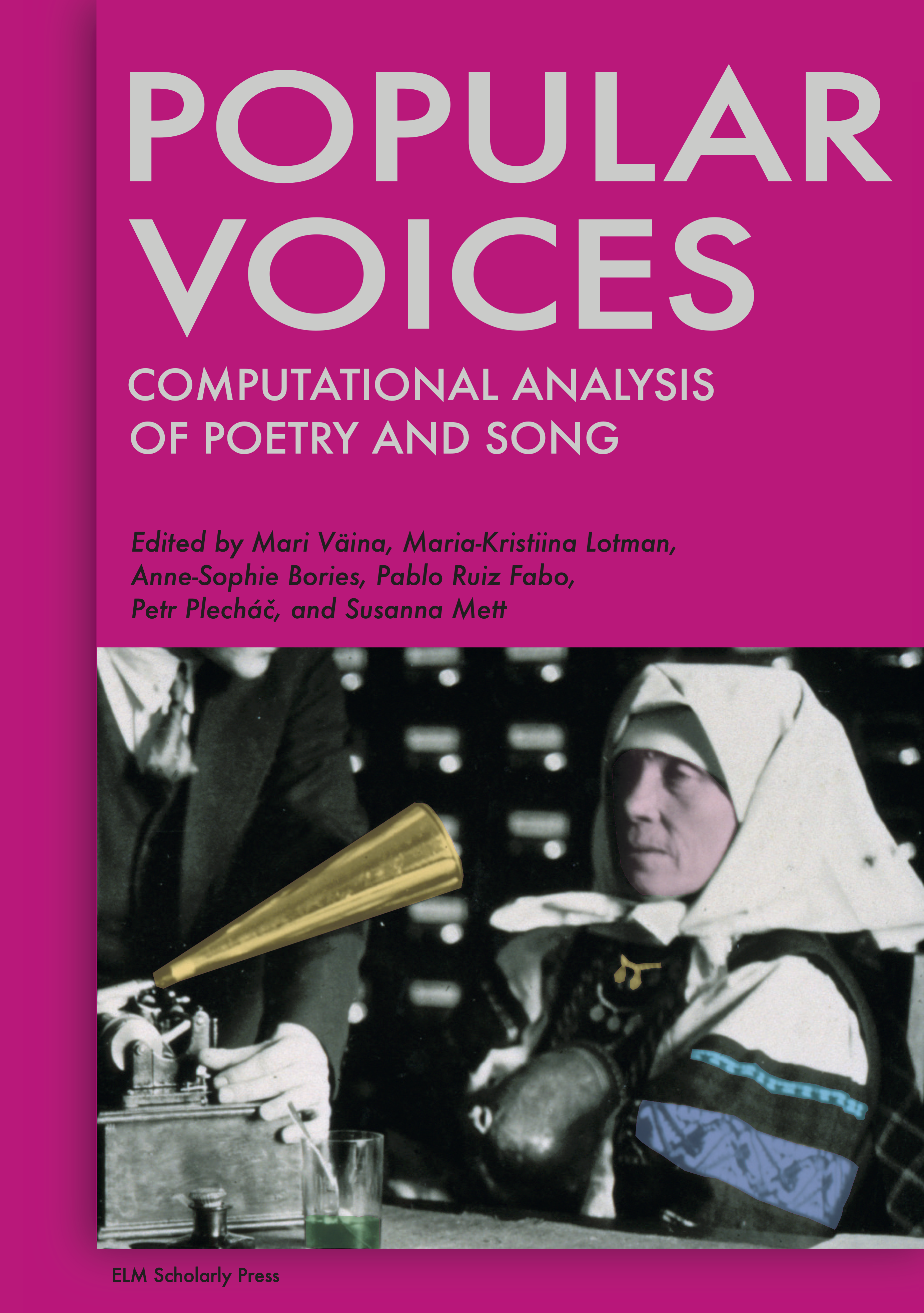
© Cover design: Anne-Sophie Bories
Published under Creative Commons Attribution 4.0 International License (CC BY 4.0)